
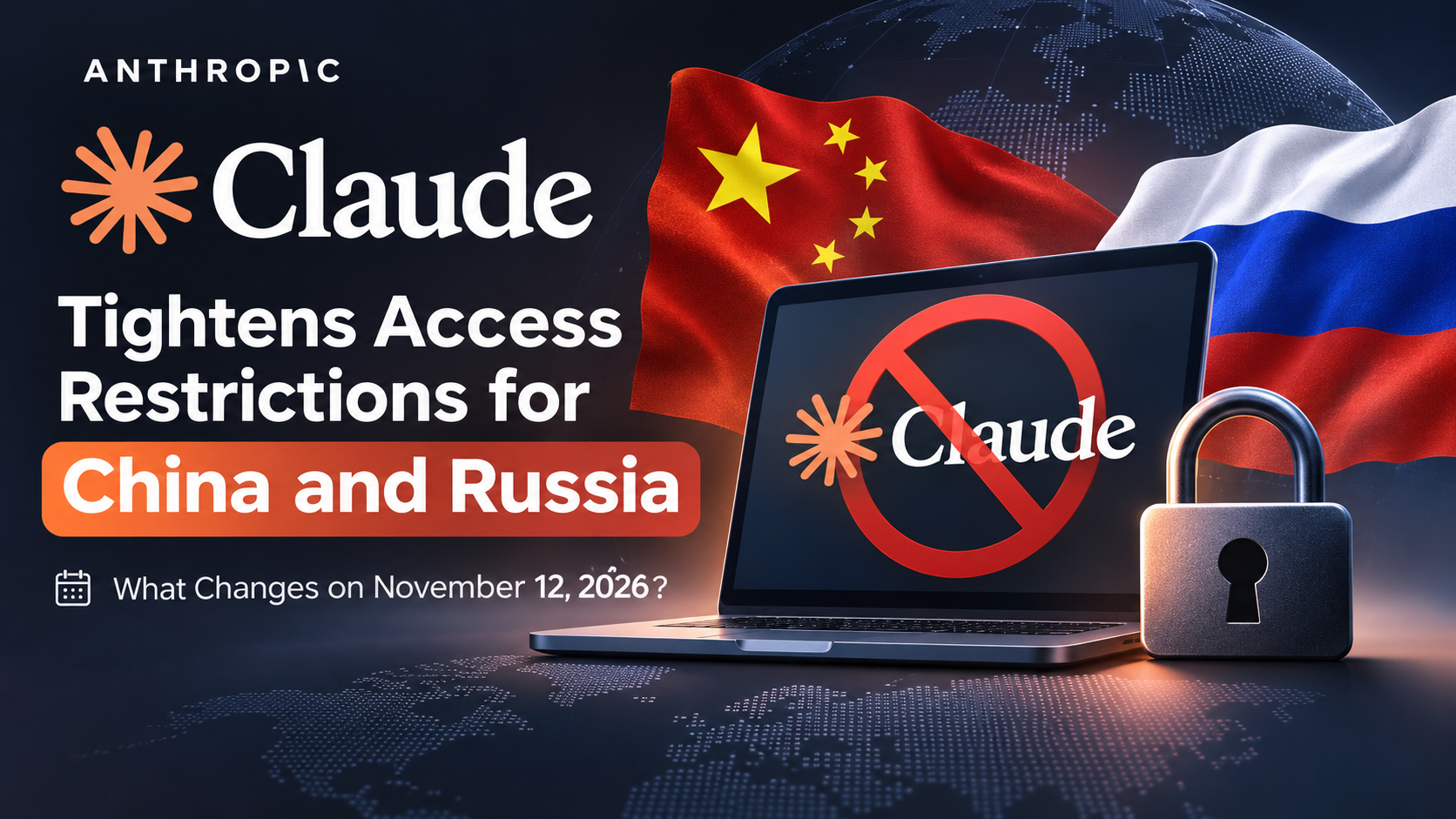
Anthropic Tightens Claude Access Restrictions for China and Russia: What Changes on November 12, 2026?
Anthropic's updated policies, effective November 12, 2026, clarify restrictions on Claude access for individuals and businesses connected to unsupported regions, including China and Russia. The rules extend beyond geographic location, potentially affecting overseas subsidiaries, multinational companies, and developers using Claude's API.
Claude Restrictions Go Beyond Geographic Borders
Anthropic, the company behind the Claude AI assistant, has drawn renewed attention following updates to its policies governing access to its artificial intelligence services.
Effective November 12, 2026, Anthropic's updated Usage Policy accompanies existing restrictions affecting unsupported regions, including China and Russia.
However, these restrictions are not entirely new.
In September 2025, Anthropic expanded its sales restrictions to cover certain companies owned or controlled by entities based in unsupported regions.
The latest policy framework reinforces an important distinction: access to Claude is not determined solely by where someone connects to the internet.
A company's registration, headquarters, ownership, and control structure may also determine eligibility.
Who Is Affected by the Restrictions?
Anthropic's Supported Regions Policy identifies several categories of users and organizations that may be restricted from accessing its services.
1. Individuals Located in China or Russia
Users physically located in unsupported regions, including mainland China and Russia, are generally not permitted to access Claude under Anthropic's regional availability rules.
This restriction can apply even when an individual works for an organization headquartered in a supported country.
2. Companies Registered or Headquartered in China or Russia
Organizations incorporated or headquartered in unsupported regions may be prohibited from accessing Claude, including through employees operating overseas.
Establishing an overseas office does not automatically exempt an organization from Anthropic's restrictions.
3. Overseas Companies Owned or Controlled by Restricted Entities
One of the most significant elements of Anthropic's policy concerns corporate ownership.
In its September 2025 announcement, Anthropic explicitly extended restrictions to organizations more than 50% owned, directly or indirectly, by companies headquartered in unsupported regions.
The policy also addresses certain control relationships that may bring additional entities within its scope.
As a result, a company operating in Singapore, Vietnam, or another supported market could still face restrictions depending on its ownership and control structure.
4. Developers Using Claude Through Third-Party Platforms
The restrictions are not limited to the Claude chatbot.
They also affect access to Anthropic's broader ecosystem, including:
- Claude.ai — Anthropic's AI assistant.
- Claude Code — AI-powered coding tools.
- Claude API — Developer access to Claude models.
- Claude-powered development workflows — Integrations and automation.
- Cloud platforms and authorized resellers — Third-party access to Claude models.
Using an intermediary service does not automatically override Anthropic's eligibility requirements.
Why Is Anthropic Restricting Access in China and Russia?
Anthropic has cited national security, AI misuse, and concerns about the transfer of advanced AI capabilities as reasons for maintaining restrictions on unsupported regions.
The company argues that allowing organizations in restricted jurisdictions to access Claude through overseas subsidiaries could undermine its safeguards.
Another major concern involves AI model distillation.
What Is AI Model Distillation?
AI distillation is a machine learning technique in which outputs from a more capable model are used to train another model.
While distillation has legitimate applications, unauthorized large-scale extraction of proprietary model capabilities can violate a provider's terms of service.
Anthropic's Allegations Against Chinese AI Laboratories
On February 23, 2026, Anthropic published findings alleging that three Chinese AI laboratories had conducted coordinated distillation campaigns targeting Claude.
The laboratories identified were:
- DeepSeek
- Moonshot AI
- MiniMax
According to Anthropic, the campaigns involved:
| Metric | Anthropic's Reported Findings |
|---|---|
| Total interactions | More than 16 million |
| Fraudulent accounts | Approximately 24,000 |
| Organizations identified | DeepSeek, Moonshot, MiniMax |
| Alleged objective | Extract advanced model capabilities |
| Report publication | February 23, 2026 |
Anthropic alleged that these activities were intended to improve competing AI systems using Claude-generated outputs.
Important: These figures and allegations originate from Anthropic's investigation. They should not be interpreted as independently established findings about the Chinese AI industry as a whole.
The report nevertheless illustrates why Anthropic considers unauthorized model extraction a significant security and commercial concern.
Russian Users Abroad Report Account Suspensions
The controversy also extends to individual users.
On October 29, 2026, Meduza reported that several Russian citizens had experienced Claude account suspensions after completing identity verification using Russian passports.
Some reported cases involved individuals living outside Russia, including:
- New Zealand
- Georgia
- Armenia
These reports raised questions about whether nationality, rather than geographical location or corporate affiliation, was influencing account enforcement.
However, Anthropic's publicly documented regional policy does not establish a blanket prohibition on all Russian citizens living abroad.
The reported incidents therefore should not be interpreted as proof that every Russian passport holder is automatically banned from Claude.
Anthropic had not publicly provided a comprehensive explanation for the specific account suspensions described in those reports.
What Actually Changes on November 12, 2026?
Anthropic announced its updated Usage Policy on October 8, 2026, with an effective date of November 12, 2026.
Importantly, November 12 does not mark the introduction of an entirely new ban on China and Russia.
Instead, the update forms part of a broader policy framework addressing responsible AI deployment and misuse.
The updated rules address areas such as:
- Disinformation: Coordinated disinformation and deceptive influence operations.
- Election integrity: Election-related manipulation and misleading political activities.
- Weapons development: Development of prohibited weapons-related systems and components.
- Surveillance: Unauthorized surveillance and privacy violations.
- High-risk decisions: Certain uses of AI in healthcare, finance, and legal services.
- Model misuse: Other prohibited forms of AI misuse.
The geographical and corporate ownership restrictions must therefore be understood alongside, rather than confused with, the broader Usage Policy update.
For additional context, see Anthropic's October 2026 Usage Policy announcement.
What Does This Mean for International Developers and Businesses?
The implications extend beyond China and Russia.
Companies operating internationally increasingly rely on advanced AI models for software development, automation, customer support, research, and business operations.
For developers using Claude Code or the Claude API, regional eligibility and corporate ownership requirements may create additional compliance considerations.
Example: A Technology Company Operating in Vietnam
Consider a technology company registered in Vietnam but majority-owned by a company headquartered in an unsupported region.
Although Vietnam is included in Anthropic's supported regions, the company's ownership structure could potentially bring it within Anthropic's restrictions.
Similarly, a developer working outside Russia for a company headquartered in Russia may not automatically qualify for access simply because their current location is supported.
How Should Businesses Prepare?
Organizations integrating Claude into critical workflows should consider:
- Reviewing Anthropic's supported regions and applicable policies.
- Evaluating corporate ownership and control requirements.
- Checking contractual eligibility for Claude API and Claude Code.
- Monitoring policy changes that could affect access.
- Maintaining alternative AI providers or deployment options where appropriate.
- Avoiding dependence on a single external AI service for critical operations.
These measures can help reduce operational disruption if access requirements change.
A Broader Shift in the Global AI Industry
Anthropic's approach highlights an increasingly important development in the global artificial intelligence market.
Access to advanced AI models is becoming influenced by more than technical capability, subscription fees, or internet connectivity.
Corporate ownership, international security concerns, and provider-specific compliance requirements are becoming significant factors.
For multinational organizations, this introduces new operational considerations.
A company may be technically capable of integrating an AI model but still face contractual restrictions based on where it operates or who controls it.
For AI developers, the situation also highlights the importance of understanding the terms governing third-party models and maintaining flexibility in infrastructure decisions.
Conclusion
Anthropic's restrictions affecting China and Russia demonstrate how access to advanced AI technology is increasingly shaped by geographical, corporate, and security considerations.
The November 12, 2026 policy update should not be mistaken for the first introduction of these restrictions. Rather, it reinforces a broader framework that Anthropic has developed over time.
The distinction matters for individuals, developers, and multinational businesses seeking to understand whether they can legally and contractually access Claude.
As advanced AI becomes essential to software development and enterprise operations, understanding provider policies may become just as important as evaluating model performance.
Sources and References
- Anthropic — Supported Regions Policy
- Anthropic — 2026 Usage Policy Update — October 8, 2026
- Anthropic — Updating Restrictions on Sales to Unsupported Regions — September 4, 2025
- Anthropic — Detecting and Preventing Distillation Attacks — February 23, 2026
- Meduza — Russian Claude Users Report Account Bans — October 29, 2026
- Meduza — Clarifying Reports of a New Claude Ban — November 12, 2026
About the author
A passionate full-stack developer from @ePlus.DEV
Comments
Join the discussionNo comments yet. Be the first to comment.
News
Stay informed with our News category. Get the latest updates on events, trends, business, technology, and more. Stay ahead in the modern world.