Jev: A New AI Primitive for Software — or Just a Faster Classifier?
A passionate full-stack developer from @ePlus.DEV
Vietnamese version follows the English version below.
AI models have become extremely good at talking, writing, coding, and reasoning. Yet there is still an awkward question:
If AI is so capable, why is so much software automation still built with ordinary if/else statements?
TypeSafe AI believes one reason is that modern large language models were designed primarily to generate language, not to become reliable components inside software.
On September 15, 2026, TypeSafe introduced Jev, its first public System One Model, designed specifically for fast, structured decisions inside software.
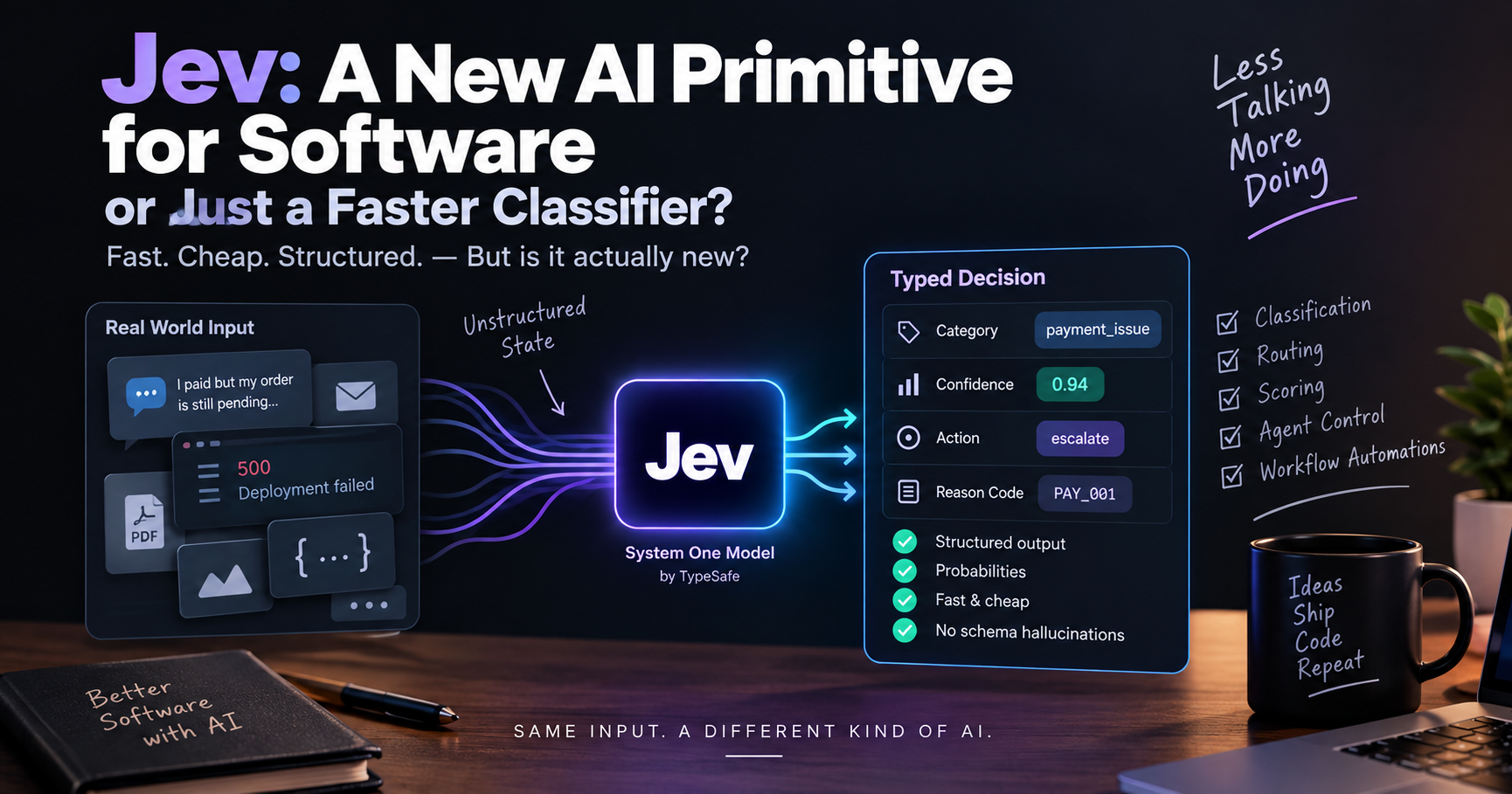
Instead of generating text, Jev takes application state and returns typed decisions, probabilities, and confidence scores.
At first glance, this sounds interesting.
But it also raises another question:
Haven't neural networks and LLMs already been doing this for years?
The answer is yes — and that is exactly why Jev is worth analyzing carefully rather than simply accepting the marketing.
What is Jev?
TypeSafe describes Jev with a simple idea:
unstructured state in → typed probabilistic decisions out

https://x.com/CompleteSkeptic/status/2099925682726002904?s=20
Traditional LLMs usually work like this:
Input
  ↓
LLM
  ↓
Tokens
  ↓
Text / JSON
Jev is intended to work more like:
Application state
      ↓
     Jev
      ↓
Typed decision
+ probability
+ confidence
For example, imagine a customer sends:
"I paid yesterday, but my order is still showing as unpaid."
An LLM might generate:
{
  "category": "payment_issue",
  "confidence": 0.94
}
Jev could conceptually return the same kind of decision, but the important difference is architectural: the possible outputs are defined in advance and are intended to be consumed directly by software.
TypeSafe currently exposes three decision primitives in its workflow evaluations: Noul, which answers a yes/no question with a probability; Choice, which selects among predefined options; and Score, which evaluates something along a scale.
That makes Jev look less like a chatbot and more like an intelligent function call.
But haven't neural networks done this for decades?
Yes.
A traditional classifier can already do:
input features
     ↓
 neural network
     ↓
spam      0.97
not spam  0.03
Image classifiers, fraud detection systems, recommendation engines, credit models, anomaly detectors, and countless other machine-learning systems have been returning probabilities for years.
Traditional ML also has several advantages over general-purpose LLMs.
Once trained, a specialized classifier can be extremely cheap, fast, deterministic in structure, and easy to integrate into software.
The problem is what happens before deployment.
You often need to define features, collect a labeled dataset, train a model, evaluate it, deploy it, monitor it, and retrain it as the world changes.
That can be a lot of engineering for a relatively small business decision.
Jev is trying to occupy a different position.
Traditional ML                  LLM
      │                          │
fast / cheap                flexible / general
task-specific                understands text
needs training              prompt-driven
      │                          │
      └──────── Jev ────────────┘
The promise is essentially:
Can we get the convenience and generality of an LLM while retaining the speed and structured output of a classifier?
That is much more interesting than simply saying "Jev can classify things."
What about LLM structured output?
This is the bigger challenge to Jev's value proposition.
Modern LLM APIs can already return schema-constrained JSON.
A developer can define something like:
type Decision = {
  category:
    | "payment"
    | "shipping"
    | "refund";

  severity:
    | "low"
    | "medium"
    | "high";
};
and ask an LLM to return exactly that structure.
So typed output alone is not a new capability.
TypeSafe itself acknowledges the comparison. Its evaluations even run conventional LLMs through a wrapper that constrains them to the same structured decision interface used by Jev.
The real argument is therefore not:
"Jev can do something LLMs cannot."
It is:
"Jev may perform this particular kind of task much more efficiently."
That distinction matters.
The most interesting difference: Jev does not generate strings
An LLM normally generates output autoregressively.
That means:
token 1
 ↓
token 2
 ↓
token 3
 ↓
token 4
 ↓
...
Each token depends on previous tokens.
This flexibility is incredibly powerful because it allows an LLM to generate articles, code, explanations, emails, SQL, conversations, and almost anything representable as text.
But it also has a cost.
Jev deliberately gives up that flexibility.
Its outputs are predefined decisions rather than arbitrary strings.
TypeSafe says Jev can evaluate outputs in parallel instead of generating a response token by token. According to the company, this allows end-to-end response times of roughly 70–500 ms for the kinds of System One queries it targets.
This is arguably the core idea behind Jev:
Do less, but do that smaller class of tasks much more efficiently.
"Zero hallucinations" needs an important clarification
TypeSafe prominently markets Jev as having zero hallucinations and says schema matching is guaranteed.
That statement can easily be misunderstood.
Suppose the only valid outputs are:
APPROVE
REVIEW
REJECT
Jev will not suddenly return:
SEND_TO_MARS
That is a meaningful property for production software.
The output stays within the defined type.
However:
APPROVE
can still be the wrong decision.
A model being unable to produce an invalid data type is not the same thing as a model being unable to make an incorrect prediction.
This distinction is especially important for developers evaluating Jev for payment, fraud, moderation, security, or other sensitive systems.
A better interpretation of TypeSafe's claim is:
Jev is designed to eliminate schema/type hallucination, not uncertainty or incorrect judgment.
And that is why probabilities and confidence scores matter.
Confidence may be more important than the answer
Suppose a system predicts:
fraud probability = 0.92
That number becomes genuinely useful only if the probability is well calibrated.
For example, among a large set of predictions made with approximately 90% confidence, we would ideally expect roughly 90% of those predictions to be correct.
TypeSafe says it trains System One Models using a method it calls Reinforcement Learning for Calibrated Decisions (RLCD).
Instead of optimizing primarily for text preferred by humans, the stated objective is calibrated decision-making and honest representation of uncertainty.
This could be one of Jev's more interesting technical properties.
For example:
confidence > 0.95
      ↓
automatic action

0.70 – 0.95
      ↓
additional verification

confidence < 0.70
      ↓
human review
If confidence is genuinely calibrated, developers can build automation around it.
If it is not calibrated, then the confidence number becomes mostly decorative.
This is therefore an area where independent evaluation will matter considerably.
Why is Jev so cheap?
At launch, TypeSafe lists Jev at:
$0.042 / 1 million input tokens
$42 / 1 billion input tokens
output: free
That is extremely inexpensive compared with general-purpose frontier LLMs.
But Jev is not producing long responses.
There is no essay, reasoning trace, explanation, or generated code.
It is effectively selling intelligence used for decisions, rather than intelligence used for content generation.
This pricing could make a major difference at scale.
Imagine each decision uses around 1,000 input tokens:
1,000,000 decisions
× 1,000 input tokens
= 1 billion tokens

≈ $42
For applications evaluating millions of events, messages, transactions, logs, agent traces, or workflow states, that becomes interesting.
For an application making only a few hundred decisions per day, the economic advantage probably matters far less.
TypeSafe itself also notes that it cannot yet prove the long-term sustainability of its current pricing because the product is new.
So the launch price should not automatically be interpreted as a permanent law of economics.
What do the benchmarks show?
TypeSafe published workflow evaluations around areas such as security incidents, agent trace observability, invoice processing, and customer service.
Instead of giving a model one giant prompt, the workflow breaks a problem into smaller judgments and lets ordinary code handle deterministic rules.
For example:
Incoming event
      ↓
Is this suspicious?
      ↓
How severe is it?
      ↓
Does it require review?
      ↓
Code decides action
This is actually a useful architectural lesson even if you never use Jev.
TypeSafe reports some workloads where Jev reached up to 193.6× lower latency and 444.6× lower cost compared with the LLM configurations in its tests. However, the company explicitly says those figures are likely near the high end of real-world gains. It also acknowledges that the workflows were built by members of its own model-capabilities team, so potential bias cannot be ruled out.
That caveat is important.
Jev was publicly released only on September 15, 2026.
There has not yet been enough time for broad independent benchmarking, years of production experience, or extensive third-party validation.
The benchmark numbers are interesting.
They should not yet be treated as universal facts.
Where Jev actually makes sense
Consider a large software platform processing millions of events.
Some decisions can be handled perfectly with deterministic code:
if (statusCode >= 500) {
  retry();
}
Do not use AI for that.
Other tasks require complex reasoning, explanation, generation, or world knowledge.
Use a capable LLM.
But there is a middle category:
Is this customer request urgent?

Does this support conversation need escalation?

Which queue should this event enter?

Is this transaction suspicious?

Does this agent trace look abnormal?

How likely is this record to be a duplicate?
These questions are difficult to express reliably with dozens or hundreds of handwritten rules, but they also do not require an AI to write 500 tokens of prose.
That is Jev's target.
A reasonable architecture might therefore become:
                 ┌───────────────┐
Simple rules ───→│ normal code   │
                 └───────────────┘

                 ┌───────────────┐
Fuzzy decision ─→│ Jev           │
                 └───────────────┘

                 ┌───────────────┐
Hard reasoning ─→│ LLM           │
                 └───────────────┘

                 ┌───────────────┐
High risk ──────→│ human review  │
                 └───────────────┘
In that architecture, Jev is not replacing LLMs.
It is filling a gap between deterministic code and generative models.
So, is Jev revolutionary?
Not yet.
Almost every individual capability Jev demonstrates already exists somewhere else.
Traditional neural networks can classify and return probabilities.
LLMs can understand messy input and return structured JSON.
Rules engines can reliably control business logic.
Existing AI APIs can route tools and classify intent.
So if we ask:
"Can Jev perform some completely new AI task?"
The answer is mostly no.
But that may be the wrong question.
The more interesting question is:
"Can Jev make a category of decisions cheap and fast enough that developers start using AI in places where LLMs were previously economically or architecturally impractical?"
If the answer eventually proves to be yes, then Jev could become important.
Not because it invented classification.
But because it may turn intelligent classification, scoring, routing, and judgment into something closer to an ordinary software primitive.
Something like:
const risk = await intelligence.score(transaction);
rather than:
construct prompt
→ call LLM
→ wait
→ generate JSON
→ parse response
→ validate response
→ retry if malformed
That is the vision TypeSafe is selling.
My take
Jev is interesting, but developers should resist both extremes.
It is too early to call it revolutionary.
It is also too simplistic to dismiss it as "just another classifier."
The most compelling aspect is not what Jev can decide.
It is the economics and interface around making those decisions.
If TypeSafe can demonstrate that Jev consistently provides useful, calibrated decisions at very low latency and cost across independent production workloads, then System One Models could become a useful new layer in the AI stack.
If those advantages disappear outside TypeSafe's own benchmarks, Jev may end up being a specialized inference service competing with structured-output LLMs and traditional ML.
As of September 2026, the right attitude is probably:
interesting architecture, impressive early numbers, but not enough independent evidence yet.
And for most developers, there is no reason to rewrite an existing system just to use Jev.
Use deterministic code when the rule is deterministic.
Use an LLM when you need generation or deep reasoning.
Consider something like Jev only when your application needs large volumes of fuzzy decisions where latency, cost, confidence, and structured output genuinely matter.
That is where Jev has a chance to become more than hype.
🇻🇳 Jev: Một primitive AI mới cho phần mềm, hay chỉ là classifier nhanh hơn?
AI hiện nay đã cực kỳ giỏi trò chuyện, viết nội dung, lập trình và reasoning.
Nhưng vẫn có một câu hỏi khá thú vị:
Nếu AI đã mạnh như vậy, tại sao phần lớn automation trong phần mềm vẫn dựa vào if/else?
TypeSafe AI cho rằng một phần nguyên nhân nằm ở kiến trúc của LLM.
LLM được tối ưu để sinh ngôn ngữ, trong khi phần mềm production thường không cần một đoạn văn dài. Nó cần một quyết định rõ ràng để code có thể xử lý tiếp.
Ngày 15/09/2026, TypeSafe công bố Jev, model đầu tiên thuộc nhóm mà công ty gọi là System One Models. Jev được thiết kế cho những quyết định nhanh và có cấu trúc bên trong phần mềm.
Thay vì:
Input → LLM → Text
TypeSafe muốn Jev hoạt động giống:
Application State
       ↓
      Jev
       ↓
Decision
+ Probability
+ Confidence
Nói đơn giản:
Jev không phải AI để nói chuyện. Jev là AI để phần mềm hỏi "giờ nên làm gì?".
Nhưng neural network đã làm chuyện này từ lâu rồi mà?
Đúng.
Classifier truyền thống đã có thể trả về:
spam       0.97
not spam   0.03
từ rất lâu.
Fraud detection, recommendation, computer vision, anomaly detection hay credit scoring đều hoạt động theo nguyên lý tương tự.
Vì vậy bản thân việc:
input → probability
không phải phát minh mới của Jev.
Điểm khác nằm ở trải nghiệm phát triển.
Với ML truyền thống, bạn thường phải trải qua:
collect dataset
→ label
→ feature engineering
→ train
→ evaluate
→ deploy
→ monitor
→ retrain
Trong khi LLM chỉ cần:
prompt + dữ liệu
→ decision
Jev đang cố gắng đứng giữa hai thế giới:
Traditional ML                    LLM
      │                             │
nhanh + rẻ                  linh hoạt + tổng quát
model riêng                  hiểu text tốt
cần training                 dùng prompt
      │                             │
      └────────── Jev ──────────────┘
Ý tưởng thực sự của Jev là:
lấy sự linh hoạt của LLM nhưng có performance và interface gần với classifier.
Structured Output của LLM đã làm được rồi
Đây là phần khiến Jev dễ bị xem là "không có gì mới".
Hiện tại developer hoàn toàn có thể bắt LLM trả:
{
  "category": "shipping",
  "severity": "high",
  "needs_review": true
}
theo JSON Schema.
Vì vậy:
Typed output không phải lợi thế độc quyền của Jev.
Ngay cả benchmark của TypeSafe cũng dùng wrapper để buộc các LLM khác trả decision theo cùng kiểu interface với Jev.
Do đó câu chuyện không phải:
Jev làm được thứ LLM không làm được.
Mà là:
Jev có thể làm cùng một nhóm công việc nhanh và rẻ hơn bao nhiêu?
Đây mới là thứ cần quan tâm.
Jev bỏ khả năng sinh text
LLM tạo output tuần tự:
token
 ↓
token
 ↓
token
 ↓
token
Đó là lý do LLM cực kỳ linh hoạt.
Nó có thể viết:
code
email
SQL
blog
conversation
analysis
Nhưng sự linh hoạt này cũng tạo overhead.
Jev chủ động từ bỏ khả năng sinh string tùy ý.
Output được định nghĩa trước.
Ví dụ:
Choice:
payment
shipping
refund
fraud
hoặc:
Score:
0 ───────────── 10
TypeSafe cho biết các output có thể được xử lý song song thay vì autoregressive như LLM và công bố latency khoảng 70–500 ms cho nhóm System One query mà Jev nhắm tới.
Có thể tóm tắt triết lý này bằng một câu:
Jev làm ít thứ hơn LLM để làm những thứ đó hiệu quả hơn.
"Zero Hallucinations" không có nghĩa là Jev không bao giờ sai
Đây là claim cần đọc cẩn thận.
Giả sử schema chỉ cho:
APPROVE
REVIEW
REJECT
Jev sẽ không trả về:
SEND_TO_MARS
Theo TypeSafe, schema matching được đảm bảo và model không tạo type error.
Điều đó rất hữu ích cho production.
Nhưng Jev hoàn toàn vẫn có thể trả:
APPROVE
trong khi quyết định đúng phải là:
REJECT
Hai khái niệm khác nhau:
invalid output
≠
wrong decision
Vì vậy "zero hallucination" nên được hiểu gần hơn với:
không hallucinate cấu trúc/type của output.
Nó không đồng nghĩa với:
100% accuracy.
Phần đáng chú ý hơn là confidence
Ví dụ Jev nói:
fraud = 92%
Con số này chỉ hữu ích nếu nó được calibration tốt.
Nếu model đưa confidence khoảng 90% cho 10.000 trường hợp tương tự, chúng ta muốn tỷ lệ đúng thực tế cũng gần 90%.
TypeSafe gọi kỹ thuật training của mình là:
RLCD — Reinforcement Learning for Calibrated Decisions.
Mục tiêu được công ty mô tả là tối ưu model cho các quyết định có probability và uncertainty hữu ích thay vì chủ yếu tạo câu trả lời mà con người thích đọc.
Nếu calibration thực sự tốt, chúng ta có thể xây:
confidence > 95%
       ↓
auto process

70–95%
       ↓
additional verification

< 70%
       ↓
human review
Đây có thể là một đặc điểm quan trọng hơn rất nhiều so với việc Jev trả JSON.
Jev rẻ đến mức nào?
Giá TypeSafe công bố tại thời điểm ra mắt là:
$0.042 / 1M input tokens

tức:

$42 / 1 tỷ input tokens
Output hiện không tính phí.
Giả sử một lần decision cần:
1,000 tokens
thì:
1,000,000 decisions
×
1,000 tokens

= 1 tỷ tokens

≈ $42
Đây là mức giá cực kỳ thú vị nếu hệ thống phải xử lý:
millions of events
transactions
messages
logs
agent traces
mỗi ngày.
Nhưng nếu app của bạn chỉ gọi AI vài trăm lần/ngày thì sự khác biệt về chi phí gần như không quan trọng.
TypeSafe cũng thừa nhận hiện còn quá sớm để chứng minh mức giá này có bền vững trong dài hạn hay không.
Benchmark rất đẹp, nhưng nên cẩn thận
TypeSafe đã công bố các workflow evaluation cho:
Security Incidents
Agent Trace Observability
Invoice Processing
Customer Service
Triết lý của họ khá hợp lý:
Đừng bắt AI giải quyết cả workflow.

Chia workflow thành:
code deterministic
+
nhiều decision nhỏ.
Trong benchmark của mình, TypeSafe công bố có trường hợp Jev đạt đến khoảng:
193.6× faster
444.6× cheaper
so với cấu hình LLM được sử dụng trong thử nghiệm.
Nhưng có hai chi tiết rất quan trọng.
TypeSafe nói chính họ rằng đây có thể là mức gain thuộc nhóm cao của thực tế.
Ngoài ra, workflow được xây dựng bởi chính team model-capabilities của TypeSafe, nên công ty cũng thừa nhận khả năng tồn tại bias.
Đây là cách công bố benchmark khá minh bạch.
Nhưng Jev mới ra mắt ngày 15/09/2026.
Chúng ta vẫn cần:
independent benchmarks
production workloads
long-term reliability data
third-party evaluation
trước khi coi những con số này là kết luận chung.
Use case nào thực sự cần Jev?
Nếu bạn có rule:
if (status >= 500) {
  retry();
}
hãy tiếp tục dùng code.
Không cần AI.
Nếu bạn cần:
viết email
generate code
research
reasoning phức tạp
hãy dùng LLM.
Nhưng có một vùng nằm giữa:
Ticket này có khẩn cấp không?

Conversation này có cần chuyển human không?

Event này thuộc queue nào?

Transaction này có đáng ngờ không?

Agent vừa thực hiện có hành vi bất thường không?

Hai record này có khả năng duplicate không?
Đây là các fuzzy decisions.
Viết hàng trăm if/else rất khó.
Nhưng dùng một frontier LLM generate cả response cũng có thể quá mức cần thiết.
Đó chính là vùng mà Jev đang nhắm tới.
Kiến trúc tương lai có thể giống:
Simple problem
     ↓
normal code

Fuzzy decision
     ↓
Jev

Hard reasoning
     ↓
LLM

High-risk decision
     ↓
Human
Jev lúc này không thay thế LLM.
Nó bổ sung một tầng mới giữa:
deterministic software
↕
generative AI
Jev có thực sự đột phá?
Hiện tại mình chưa nghĩ vậy.
Nếu xét từng capability riêng lẻ thì gần như không có gì hoàn toàn mới.
Neural network đã classification từ lâu.
Classifier đã trả probability từ lâu.
LLM đã hiểu unstructured text.
LLM đã có structured output.
Rules engine đã điều khiển workflow.
Tool routing cũng đã tồn tại.
Nhưng có thể chúng ta đang đặt sai câu hỏi.
Câu hỏi quan trọng hơn không phải:
Jev có làm được thứ chưa từng tồn tại không?
Mà là:
Jev có làm một nhóm công việc AI rẻ và nhanh đến mức developer bắt đầu dùng intelligence ở những nơi trước đây không đáng dùng LLM không?
Nếu câu trả lời cuối cùng là có, thì Jev vẫn có thể trở thành một sản phẩm quan trọng.
Không phải vì nó phát minh ra classification.
Mà vì nó có thể biến:
classification
routing
scoring
judgment
thành một primitive gần giống function bình thường:
const risk =
  await intelligence.score(transaction);
Kết luận
Jev đang ở một vị trí khá thú vị.
Gọi nó là một cuộc cách mạng AI vào thời điểm hiện tại là quá sớm.
Nhưng gọi nó đơn giản là một classifier cũ được đổi tên cũng có thể bỏ qua điểm quan trọng nhất.
Điểm đáng quan tâm không nằm ở Jev biết quyết định cái gì.
Nó nằm ở:
chi phí, latency, probability calibration và cách decision được đưa trực tiếp vào software.
Nếu những lợi thế mà TypeSafe công bố tiếp tục tồn tại khi Jev được benchmark độc lập và chạy trên workload production thực tế, System One Models có thể trở thành một layer hữu ích trong AI stack.
Nếu không, Jev có thể chỉ trở thành một inference service chuyên biệt cạnh tranh với:
traditional ML
+
structured-output LLMs
Tính đến tháng 9/2026, mình sẽ mô tả Jev bằng một câu:
Interesting architecture, impressive early numbers, but not enough independent evidence yet.
Hay tiếng Việt:
Kiến trúc đáng quan tâm, số liệu ban đầu khá ấn tượng, nhưng vẫn còn quá sớm để gọi đây là một cuộc cách mạng.
Với developer, nguyên tắc vẫn rất đơn giản:
Rule rõ ràng
→ code

Cần generation/reasoning
→ LLM

Cần hàng triệu fuzzy decisions
→ lúc đó hãy nghĩ đến Jev
Và chính use case cuối cùng mới là nơi Jev có cơ hội chứng minh rằng nó thực sự cần thiết.